Donor Story
A Life-Changing Gift
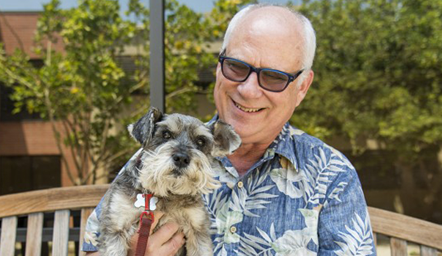
Ed Griganavicius was only 45 years old when he received a new heart through
the donor program at the UCLA Health Cardiovascular Center on January 12,
2010. "It's my second birthday," says Ed, who turns 60 this year. "If it
wasn't for UCLA's dedicated team of professionals and the organ transplant
program, I wouldn't be here today."
A trusted team — An avid climber, hiker, and skier, Ed was diagnosed with heart failure due
to a genetic mutation that runs on his mother's side of the family. When
researching local heart transplant programs, Ed was immediately drawn to
UCLA's innovative research and successful outcomes.
"I looked at numerous heart transplant programs and realized I probably had
the best one in my backyard," Ed recalls. "One of the reasons I chose UCLA
is that their transplant program also extends to older adults. There is a
high likelihood that I will have another heart transplant within my
lifetime."
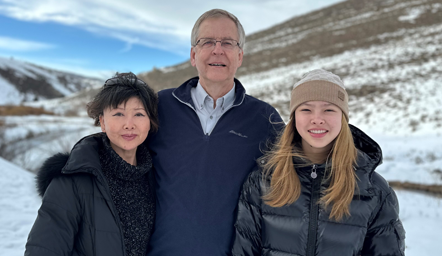
Trusting his UCLA medical team allowed him to concentrate on what mattered
most to him during his illness—his wife, Lisa, and their two-year-old
daughter, Lauren. If Ed had not received a heart transplant, the plan was
for his wife to relocate to her native Beijing, where her extended family
could help bring up their daughter. "A lot of positives came out of this,
including the fact that our daughter is being raised in this great
country," Ed says.
Ed credits his entire UCLA medical team—particularly Dr. Abbas Ardehali,
Dr. Daniel Cruz, and Stephanie Lackey—for seeing him through every part of
the journey to his new heart. Throughout the entire process, Ed remained
positive. "I had a lot to hope for—I had a two-year-old," he says."I
remember being wheeled on the gurney into the surgery room, and the nurse
was very solemn. And I said, 'I'm getting a gift today.'"
Paying it forward — Not a day
goes by that Ed doesn't feel grateful for that gift—and to the donor who
made his recovery possible. "Somebody made the conscious choice that upon
death they were going to benefit somebody else," Ed says. "It's not a
question of should I give back. I have to. Not to give back would be
selfish and definitely not in the spirit of the donor program and the
medical care that allowed me to receive the transplant—and extend my life."
On January 12 of this year—exactly 14 years after Ed's heart transplant—Ed
finalized a bequest to The UCLA Foundation that will help benefit future
transplant patients. He hopes this gift will help reduce health disparities
and promote health equity for those who do not have the same financial
flexibility and access to health insurance that his family had.
In the years since his surgery, Ed retired and he and his family have
enjoyed his favorite outdoor activities. He even has plans to take his
daughter heliskiing this year. "We're in a position where we're doing a lot
more reflection on the gift that I received," Ed says. "It's not just about
giving back. It's about paying it forward and ensuring that others that are
awaiting transplant have the same opportunity as I did."